Abstract
Modern software systems often follow a microservice architecture, where each service is responsible for a specific business capability. While this provides modularity and scalability, it introduces challenges when multiple services must be queried to produce a unified result — particularly in reporting or data aggregation use cases. This paper introduces a novel architectural concept titled Backend for Backend (BFB), a dedicated backend service designed to aggregate and orchestrate data from multiple other backend services. BFB simplifies access to scattered data sources, reduces code duplication, and provides a central point for backend-to-backend communication.
1. Introduction
As microservices become a standard architectural pattern, systems are increasingly composed of loosely coupled services, each owning a distinct set of responsibilities. While this improves maintainability and scalability, it often introduces a pattern of repetitive logic when higher-level services (e.g., reporting services) require access to data scattered across several underlying microservices.
For example, consider the following services:
-User Calls Service — handles and stores information about user phone calls.
-User Emails Service — manages user email data.
-User SMS Service — stores and processes user text message data.
Now suppose we have services such as:
-Admin Report Service
-Manager Report Service
-User Report Service
Each of these reporting services requires access to data from the above-mentioned services. Implementing this data fetching logic in every reporting service leads to code duplication, maintenance overhead, and inconsistent behavior.
This is where Backend for Backend (BFB) comes into play — a service that acts as an intermediary layer between internal backend services, aggregating and serving data through a unified interface.
2. Problem Statement
In typical microservice ecosystems, when multiple services need to interact with the same set of data providers, the following issues arise:
— Code Duplication: Each consumer service implements the same data-fetching logic.
— Tight Coupling: Changes in data provider services require updates across all consumer services.
— Inconsistency: Different consumer services may handle data aggregation or transformation differently.
— Performance Issues: Redundant external calls from multiple services can increase latency and system load.
3. The BFB Solution
3.1 Definition
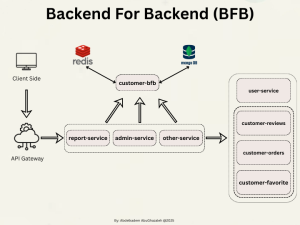
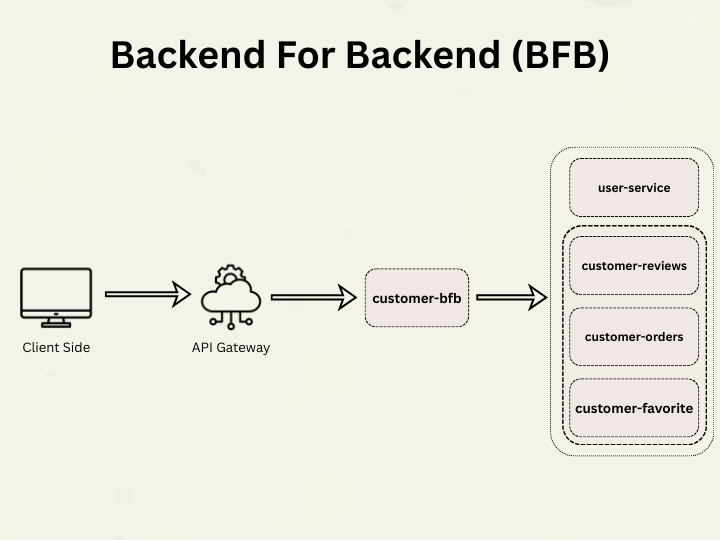
Backend for Backend (BFB) is a dedicated service layer designed to serve other backend services. It does not directly serve frontend clients or end-users. Instead, its primary role is to aggregate, normalize, and serve data from multiple internal microservices, thereby centralizing the logic that would otherwise be replicated across the system.
3.2 Conceptual Architecture
Press enter or click to view image in full size

4. Use Cases
4.1 Reporting Services
BFB allows reporting modules like Admin Report, Manager Report, and User Report to retrieve a unified data object without knowing the underlying structure or number of services involved.
4.2 Cross-Service Data Composition
In cases where data must be joined or enriched from multiple services (e.g., call logs with user metadata from a different service), BFB handles this internally.
4.3 Simplified Service Contracts
By abstracting the details of multiple services behind a single interface, BFB simplifies the API contracts for its consumers.
5. Benefits
– Reduced Duplication: BFB centralizes shared logic, eliminating redundancy across services.
— Improved Maintainability: A single point of update for service integration changes.
— Consistent Aggregation: Ensures that data aggregation is standardized across different use cases.
— Decoupling: Consumer services are insulated from changes in the underlying services.
6. Implementation Considerations
– Service Discovery: BFB should be able to dynamically discover the underlying services it depends on, using service registry patterns (e.g., Eureka, Consul).
— Data Caching: To reduce response times and load on backend services, BFB can employ intelligent caching strategies.
— Error Handling: Graceful degradation strategies should be implemented in BFB to handle partial service failures.
— Security: BFB must authenticate and authorize backend consumers, and optionally, enforce downstream service security.
7. Potential Drawbacks
– Single Point of Failure: Use load balancing and failover strategies with BFB.
–Increased Latency: Apply parallel calls and caching where possible.
–Overhead in Maintenance: Apply clear service boundaries and unit testing.
8. Conclusion
Backend for Backend (BFB) provides a strategic solution to a common architectural pain point in distributed systems. By serving as an internal aggregation and orchestration layer, BFB significantly improves maintainability, reduces code duplication, and creates a clean separation of concerns. It embodies the principles of reuse, abstraction, and decoupling — key traits of scalable software architecture.
9. Future Work
– Integration with event-driven architectures (e.g., Kafka) for async aggregation.
-GraphQL layer on top of BFB to enable flexible data querying.
-AI-based dynamic aggregation optimization.
References
1. Newman, Sam. Building Microservices, O’Reilly Media, 2015.
2. Richardson, Chris. Microservices Patterns: With examples in Java, Manning Publications, 2018.
3. Martin Fowler — Microservices. https://martinfowler.com/articles/microservices.html
4. Spring Cloud Documentation. https://spring.io/projects/spring-cloud
5. API Gateway vs. Backend for Frontend (BFF). https://docs.microsoft.com/en-us/azure/architecture/patterns/backends-for-frontends