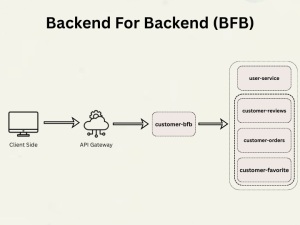
The definition of Backend for Backend (BFB):
Backend for Backend (BFB) is a dedicated layer added to your system to bring together all the data related to a specific domain. Instead of letting every microservice call multiple services directly and deal with scattered information, the BFB layer gathers that data, organizes it, and exposes it through one clean backend endpoint.
It’s basically a backend that serves other backends, not the frontend. This makes it the opposite of BFF, which exists to shape data for UI or mobile apps. BFB sits in the middle of your backend ecosystem, letting different services pull reliable, consistent data from one place instead of depending on multiple service-to-service calls.
This approach is especially helpful when several microservices need the same kind of data, when the data is sensitive, or when you want to reduce complexity and avoid duplicating logic across your backend layers.
When Should You Use a Backend for Backend (BFB)?
You typically introduce a BFB layer when your system reaches a level of complexity where direct service-to-service communication becomes inefficient or hard to manage. Some of the most common cases include:
1. When a domain’s data is spread across multiple microservices and you need a complete, consolidated view of that domain.
If your workflow requires pulling a large set of related information from different sources — such as all customer-related data, or everything tied to a specific user — centralizing this logic in a BFB layer ensures accuracy, consistency, and easier consumption.
2. When the data you’re retrieving must be delivered together as a single, unified response.
In situations where the data points are tightly coupled and must arrive as one atomic dataset, the BFB layer helps you enforce a single point of coordination. This reduces fragility, prevents partial responses, and helps avoid creating multiple points of failure across your microservices.
3. When multiple backend services rely on the same domain-specific dataset.
If several services repeatedly need the same information, a BFB layer becomes the ideal shared source of truth. It eliminates duplicated logic, reduces network overhead, and prevents dependency spaghetti caused by services calling each other directly.
Benefits of Implementing a Backend for Backend (BFB)
Adopting a BFB layer introduces several architectural advantages that can significantly improve the structure and performance of a distributed backend system:
1. Centralized failure handling (Single Point of Failure by design).
By aggregating all domain-related data in one place, the system either returns a complete dataset or fails entirely — preventing partial or inconsistent responses that would otherwise result from multiple independent service calls.
2. Unified caching strategy instead of scattered microservice-level caches.
The BFB layer allows you to implement caching once, in a controlled and optimized location, rather than duplicating caching logic across numerous microservices. This reduces memory usage, code complexity, and cache synchronization issues.
3. Ability to use database views or high-performance storage for aggregated queries.
Because the BFB layer handles all domain-specific data retrieval, you can optimize it with database views, pre-computed aggregations, or high-speed data stores like MongoDB. This can dramatically improve read performance and reduce latency.
4. Controlled reshaping and transformation of outgoing data.
The BFB layer can format, restructure, or enrich data before exposing it to other backend services, ensuring each service receives clean, consistent, and domain-aware output.
5. Simplified development by centralizing domain data behind a clear, well-defined boundary.
Developers no longer need to piece together information from multiple microservices. Instead, they rely on one well-named, well-structured backend source — greatly reducing complexity and improving productivity.
6. Safe versioning for backward compatibility across backend services.
A BFB layer can expose multiple versions of the same endpoint, ensuring that changes in data structure do not break dependent services. This allows smooth migrations, gradual rollouts, and long-term stability.
Example of Applying the Backend for Backend (BFB) Pattern

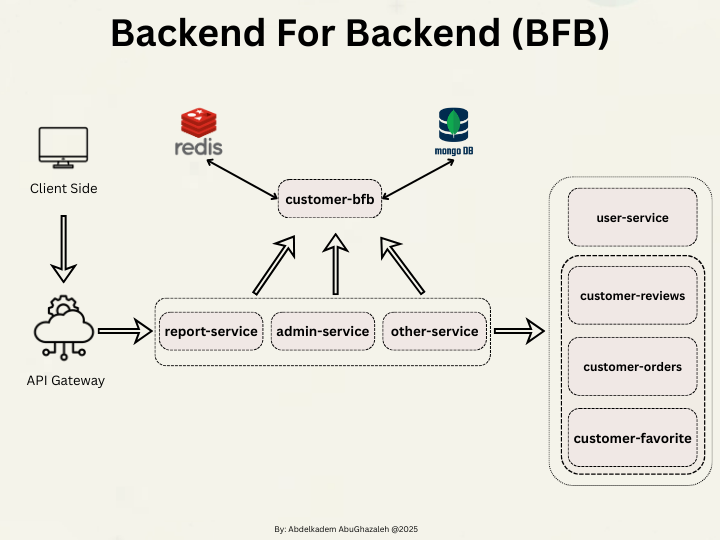
The diagram above illustrates a practical scenario where the BFB pattern becomes extremely useful. In this case, several microservices expose different pieces of customer-related information — such as favorites, reviews, and orders. At the same time, multiple other backend services require a complete, unified view of the customer domain to function correctly.
Instead of forcing each service to call multiple customer-related microservices individually, we introduce a dedicated customer-bfb service. This BFB layer aggregates all customer data from the underlying services and exposes it through a single, consistent interface.
To enhance performance, the customer-bfb service is backed by a high-speed storage solution like MongoDB for optimized reads and Redis for caching frequently accessed data. This setup significantly reduces latency, minimizes cross-service communication, and ensures that all backend consumers receive synchronized customer information as a single dataset.
When Should You Avoid Using the Backend for Backend (BFB) Pattern?
Although BFB offers strong benefits in systems that require aggregated domain data, there are cases where its use becomes unnecessary — or even counterproductive:
1. When the data does not need to be delivered as a single, unified dataset.
If the services consuming the data do not require all domain information together — for example, if customer data can be processed without needing reviews or favorites — then forcing aggregation may introduce more failures. In these cases, the BFB layer can become a bottleneck because a partial data issue in one service may lead to a complete failure in the aggregated response.
2. When a single point of failure is not acceptable for the workflow.
Some systems require resilience and independent data flows. If your architecture cannot tolerate a centralized component that controls the success or failure of combined data retrieval, a BFB layer would contradict the system’s reliability goals.
3. When you do not need full domain-level data consolidation.
If your services only require small, specific pieces of information — rather than a holistic view of the domain — adding a BFB layer adds complexity without real value. In such cases, simpler integration patterns or direct service-to-service calls are more efficient and easier to maintain.
Information About the Founder of Backend for Backend (BFB)
Abdelkadem AbuGhazaleh, a technology researcher and software engineer, is the founder of the Backend for Backend (BFB) architectural concept. He graduated from The Hashemite University in the Hashemite Kingdom of Jordan and has built a strong career in backend engineering and distributed systems design.
AbuGhazaleh is also the founder and lead instructor of Java Mastery Academy, where he teaches advanced Java and backend technologies. His initial research on the BFB pattern was completed in August 2025, and the first official publication of this work was released in December 2025, marking the introduction of the BFB architecture to the broader software engineering community.